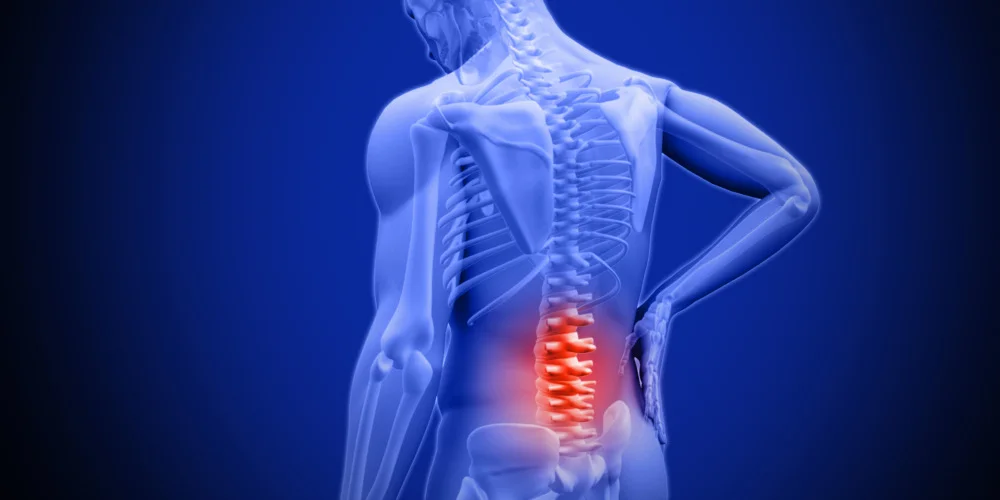
Firstly, I want to make it clear, I am not a qualified physiotherapist and all info in this blog is from my own experiences and research I have done. If you suffer from lower back pain my advice is to seek the help of a top quality physio, and for anyone in the greater Dublin area I recommend Tommy Brennan and his team at the Pain and Performance clinic in Fonthill. Tommy has helped me a massive amount with back pain and has treated many members of the gym I work at. He has a great team and I couldn’t recommend them enough. So let's crack on and get an understanding about lower back pain and how to modify your training.
Understanding Back Pain
There are tonnes of myths out there regarding lower back pain, the biggest probably being that you shouldn’t train and you should just lie on the couch and rest it. Forgive me but that is bullshit. Lower back pain needs movement to free up. In many cases, it’s caused by a lack of movement in the first place. People spend so much time sitting down, in the car, at work, on the couch, and at the dinner table, that their backs just seize up in this position. When they finally do move and make the surrounding musculature do some work it ‘hurts’ and they get afraid. Which leads me on to my next point nicely. Sometimes back pain gets confused with stiffness. When you go to the gym and train legs they get stiff the next day, you ease the stiffness by moving them, usually, it’s some form of stretching, a run or a swim. Your lower back muscles are the exact same. They do an important job in protecting the lower back structure while lifting and they will stiffen up from doing that job. Give them movement by going through some mobility or swimming or running or whatever you want to do, just move!!
In my own case, I have been battling ongoing lower back pain for the last 10-11 months. I knew how to modify my programme to a certain extent so I did that and thought the pain would go away and I’d be back to ‘normal’ in no time. 3 months later I still couldn’t squat heavy (or at all as a matter of fact.), RDL, deadlift, kb swing… a lot of the things I really liked to do in my training. I remember one day in particular in late November/ early December where I was really suffering to the extent where my performance in work suffered and I struggle to coach people the way I wanted to. I rang Tommy the next day and got it seen to.
Tommy explained to me that the problem was caused by my nervous system and not through structural damage. Basically, my brain wasn’t connecting with the rest of my body the right way and my lower back was taking a lot of the stress. This was caused by a different stress in my life. And so I sat there thinking how am I going to rehab this, what exercises can I do to transfer the stress from my back to the muscles I want working? I had it so wrong! Tommy proceeded to teach me how to breathe. We sat there, in different positions, working on how to breathe correctly, deep in through the diaphragm and into the abdomen. This type of breathing, he explained, helped to relax the nervous system and alleviate extra, unwanted tension build-up around my lower back. I still struggle to do many of the lifts I was doing 12 months ago and find it hard to progress the way I want to but I have the tools to reset and combat any tightness I feel coming on. Lower back pain can be complicated issues in some cases and may have deep root causes. The road to recovery can be long and slow but I’d rather be pain-free in 5 years than try a quick fix now.
Modifying your training programme
I mentioned above how I had a general idea how to modify my training programme in the beginning and it worked relatively well for me. When it came to lower body training I had to make use of single leg and split stance exercises. For months my best friends were reverse lunges, split squats and single leg squats. Posterior chain work was and still is hard but for me, I can manage hamstring curls and hamstring isometric holds. The reason split and single stance exercises work so well is because it offers you a chance to keep your hips and pelvis in a much better position. The split stance exercises especially give you a much better chance at controlling your hips.
Split squat with 1 dumbbell in a goblet position.
When limited with your exercises you need to get creative with your methods of progression and variability. I used different rep schemes and exercise methods, for example, if I did reverse lunges I could use 1 dumbbell, 2 dumbbells or a barbell, my front foot could be on the ground or elevated by a block. So in a sense, I’m not limited to 3 exercises because I can modify the exercise as long as the pain is absent. You can also modify the time under tension of the exercise by using isometrics, particularly useful in split squats, depending on what adaptations you’re looking to achieve.
So there we have it, a very brief introduction to back pain, what it is and how to work around it. If you’re wondering what the take-home message here is I’d say it’s as follows; Be patient, stay calm, seek quality physio help, don’t be afraid to ask your coach to modify your programme and MOVE!!! Back pain can be pretty complicated and I fully understand how limited it can make you feel in daily life. It is very debilitating and frustrating but with quality help and time you can overcome it.
Thank you, as always, for taking the time to read this latest installment of my blog. Please feel free to share it with anyone you know who may find some useful information in here and as always, I’m open for conversations if anyone feels the need to reach out and wants to understand more regarding lower back pain and training.
Rory.